Clients in divorce or child custody cases often want to record their spouses or opposing parents. Sometimes when the other party is behaving very badly, my client should be recording. All it takes is one recording of a spouse or parent screaming and cursing and saying mean, terrible things to convince a judge that the opposing party is a really bad person and everything negative being said about him or her is probably true.
I explain the law on recording to clients and tell them not to record their children, and then I recommend two recording devices made by Plaud that are for sale on Amazon. Both devices are digital, small, and are connected to AI transcription services.
In Texas, it is legal to record if you are part of the conversation and there is no requirement to let anyone know you are recording. I tell my clients:
You must be present and at least hearing with your own ears what is being said (or screamed) before you can record.
Do not leave a recording device in a room or vehicle to record what is being said when you are not present – that would be illegal.
Do not record your children. Recordings of a child cannot be used in court and they just make you look weird for doing it. If your child tells you something important, gently find out what you can and then let your lawyer know about it in detail – but do not record the kid telling the story! If a child reports what physical or sexual abuse, report it to CPS and then to the child’s therapist and then call your attorney. Do NOT record your child by saying something like, “go ahead, tell me all over again what you told me this morning about what Daddy did.”
The Plaud Note Pro AI Voice Recorder ($189 on Amazon – 4.6 stars with over 1700 reviews) is about the size of a credit card and can attach to your phone via a magnetic case. This tiny device has 5 microphones and a subscription service that creates extremely accurate AI transcriptions of conversations. The free transcription plan will transcribe up to 300 minutes per month. This device can record what is being said in the area and can also record phone conversations. The battery lasts over 30 hours.
For $368 on Amazon, you can get the Plaud Notepin and Note Pro combo, which allows even more options for recording using the small Notepin device that can go around the neck on a lanyard, be clipped to a shirt or jacket or purse, or held on the wrist like a watch.
One reviewer on Amazon wrote: So I got this several months ago, and not only does it record pretty much every conversation, but it transcribes it into hundreds of pages of perfectly printed conversations.You wear it around your neck like a necklace under your shirt it records perfectly.
Judge Angela Graves-Harrington says she is back full-time in her court after an almost nine month absence. She has returned after the regional administrative judge, with the support of Gaves-Harrington’s fellow family court judges, removed ALL cases from the 246th District Court on June 1 and after the Houston Chronicle ran a story on June 14 exposing her long absence while being paid her full $218,000 a year salary. This all happened after the judge suddenly lost her husband in October and she says her grief became so powerful that she decided it was not wise to return to court and try to make decisions for others.
The judge reports that she returned to work on June 24. A few cases have recently been given back to Graves-Harrington’s court. However, the judge has some explaining to do and she must prove herself.
Like every litigant who appears in family court, this woman deserves some compassion. We have not walked in her shoes. Most of us have not had our worlds shattered by the sudden, unexpected loss of a spouse. We all react to grief differently. She needs our empathy and support. The judge has the right to medical privacy tempered by the fact that she is an elected public servant running a court that needs a presiding judge at work every day.
I like this smart woman and I feel for her loss. I do not want anyone to think I am picking on her. But, I will publicly ask the questions everyone is asking behind her back. I will also make it clear that the family bar and the public deserve an honest explanation from the judge of what happened, how she is doing now, and her commitment for the future. The parents in family court lose most of their privacy and must testify as to all sorts of details about their personal lives and health. This judge simply has to do a little of the same and share some information about her struggles, what she has been doing for the last nine months, and her current condition. She can still keep most details of her personal life and treatment (if any) private while giving more of an explanation than she has given so far.
Below, I provide a link to e-mails from Judge Graves-Harrington explaining her position, but she provides no apology and no real details about why she was out for so long, her treatment, or her current condition. The judge’s e-mails to me speak of her “stellar reputation” but do not say if she was actually treated for depression.
I decided The Mongoose needed to return for a limited run in part because of the Graves-Harrington situation. I started this project last week planning to call for the judge to resign immediately. However, unlike the Houston Chronicle, I had a chance for a real discussion with Graves-Harrington. I truly appreciate that she was willing to talk to me. While the judge still wants to protect her privacy, I now see there is another side to this story that deserves consideration, but the judge needs to be more forthcoming.
Questions the judge really needs to answer include:
Was your return to work at the end of June actually planned? Or, was your return prompted by the embarrassment of the June 14 Houston Chronicle story? Given the drastic actions taken in the orders of your fellow judges on June 1 and 3, they must have not expected you to return as of early June. Please share e-mails showing you notified someone in advance of when you planned to come back.
If you were in such a bad mental state for months after the loss of your husband, did you get treatment? Do you have something from a professional saying you are okay to return to work and make the important decisions that only a few weeks ago you felt that you could not? If you were an airline pilot who took off work for severe depression (a move we would all approve of), you would be required to prove that you are now healthy before returning to work. If you did not get treatment, why should we believe your story of not being able to work at all? Doesn’t the public’s right to know outweigh your right to privacy? Can’t you provide a little information about your depression and treatment like County Judge Lina Hildalgo did without sharing all the details you deserve to keep private?
What did you do in the last nine months to keep your fellow judges informed about your health and your work status? It certainly appears that they all lost patience and supported Judge Brown’s extraordinary order to take away all cases from your court.
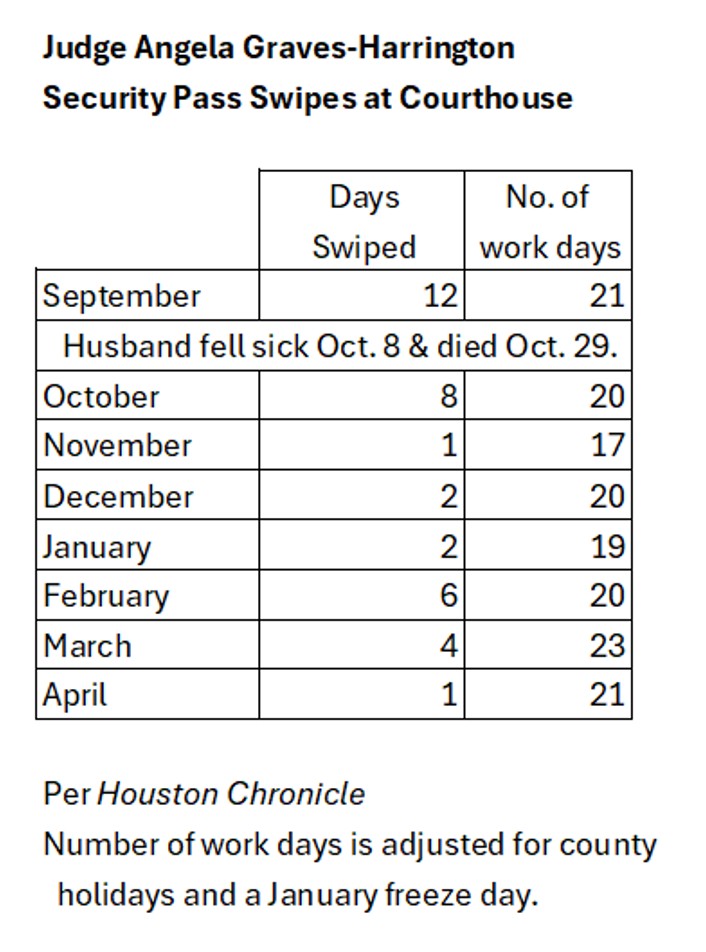
If, as you say, you were such a hard working judge up until the tragic loss of your husband, why did the Houston Chronicle find that you used your security pass to swipe into the courthouse only 12 times in September 2025, the month before your husband got sick? Would a court clerk who only worked 57% of work days keep her job? Why do some attorneys say they were waiting months to get renditions before October 2025? Will you authorize the county to release records of your courthouse security card showing dates and times you swiped in and out in 2025 and 2026? The Chronicle was only given redacted records that did not show times you entered and left the building.
Mostly importantly, don’t you feel like you owe the public and the litigants in your court an apology and a more detailed explanation as to why you did not work for over eight months? Your associate judge was left to deal with the crush of cases in your court. She did so in part by dismissing cases left and right in ways that often truly hurt families and children. If we are all to show you understanding and compassion and accept your excuse for not working for over eight months, why wasn’t that same empathy and grace shown to the lawyers and parents who had their cases dismissed during the last year in your court because some deadline had not been met even though many had very good excuses?
Someone has to ask the judge these questions we are all thinking, and so I have taken on the task. Journalism is my occasional hobby and I am not all that objective, but my articles will be. My bias is partly in favor of Judge Graves-Harrington because I always thought she was smart and fair. I also harbor a puritanical streak that expects constant hard work, especially from public servants. I have worked full time as an adult for almost 50 years. I worked most of the three day July 4 weekend. I have spent about 35 hours on this newsletter. I expect people to WORK and that too is part of my bias. I also think mental health challenges are as real as cancer and diabetes. Our society sympathizes with those suffering from physical injuries and diseases, but does not understand or empathize with those suffering from mental illness, such as depression. I saw my parents deal with the sudden loss of my 19 year old brother when I was 17. I know how absolutely profound and devasting grief can be. I also saw my parents return to their jobs full-time within a week of their oldest son’s funeral.
I plan to provide a complete and fair examination of all aspects of this situation over the next few weeks, including the duties owed by elected officials and the impact of Graves-Harrington’s absence on Houston families and her fellow judges (who all have their own share of life’s challenges and yet still manage to show up almost every day and do the work they are paid $218,000 a year to do).
Graves-Harrington is unopposed for reelection in November. She can only be removed from her office by impeachment by the legislature (which does not meet until January) or by action of the State Commission on Judicial Conduct (which can recommend removal but a Review Tribunal decides the issue subject to review by the Texas Supreme Court). A judge may enter a Voluntary Agreement to Resign with the Judicial Conduct Commission in lieu of discipline, however that is rare. The Commission can launch formal proceedings, which is the path that leads to a public censure or a removal recommendation – which takes some time.
The Texas Code of Judicial Conduct was just amended June 12, 2026 to include as grounds for discipline of a judge:
Canon 3. B. (9) A judge should dispose of all judicial matters promptly, efficiently and fairly. Willful, persistent, and unjustifiable failure to timely execute the business of the court is subject to discipline.
Some assume this rule was adopted last month because of Judge Graves-Harrington.
Article 15, Section 2 of the Texas Constitution provides for impeachment of district court judges and requires conviction by two thirds of the Senate after a trial.
So, cases may be taken away from Judge Graves-Harrington, but we are as a practical matter are stuck with her for good or ill for months (maybe 4½ years) unless she resigns.
We all should hope that Graves-Harrington is well and full of energy and determination to prove herself. If so, hallelujah. If she cannot or will not work full-time and again be that intelligent, savvy judge we respected so much during her first term, or if she will not be more forthcoming about her diagnosis and treatment, she should resign or be removed.
You can help me in this effort to consider all sides of this story by providing information, social media posts, photographs, and stories I can verify. Please email me at greg@enoslaw.com.
The opinions expressed in this blog and in The Mongoose newsletter are the opinions of Greg Enos only and not of the other attorneys who work for him (or his clients).
The Facts
Angela Graves-Harrington first introduced herself to me in September 2017, when The Mongoose was running biographies on candidates for the family courts. She told me from the start that she had been married for a long time to her high school sweetheart, the love of her life, Darryl. The woman was head-over-heels in love with her man and proud of it. Darryl Harrington fell ill on October 8 and he died unexpectedly on October 29, 2025, at age 49. His funeral was November 14. We all knew the judge was devastated and everyone expected her to be away from work for a while.
However, months passed and the judge did not return. After over eight months of the judge’s absence from the bench, the Houston Chronicle exposed what was going on. Click here to read the full June 14 article in The Houston Chronicle which said, in part:
A Democratic judge without a Republican challenger in November has been absent from her family law court for most of 2026, according to Harris County records.
This year, Judge Angela Graves-Harrington used her county-issued badge to swipe into the civil courthouse or any other county building on 13 weekdays — including just once in April, according to badge swipe data through May 13 obtained through an open-records request by the Houston Chronicle.
Outside of court, she has made public appearances in her capacity as judge. But her presence in the 246th District Court, which handles divorce, child custody and other family proceedings, has been sporadic since around the time of her husband’s death in October 2025. Her absence has continued as recently as May.
The Chronicle obtained redacted data about the number of days Graves-Harrington used her security pass at the courthouse to swipe herself in. Of course, a swipe does not mean she actually worked that day nor is there any indication how long she was at the courthouse each day. A swipe could mean she stopped by to get something from her chambers and was gone in 20 minutes or that she worked for ten hours. The lack of a swipe indicates she was not at the courthouse. Judges can do some of their work remotely, such as signing orders or reviewing cases. I calculated the number of work days in each month based on county holidays and one weather closure in January. This is what the Chronicle swipe data showed:
Unless she was on vacation in September 2025, this data indicates the judge was not at the courthouse that much in the month before her husband got sick.
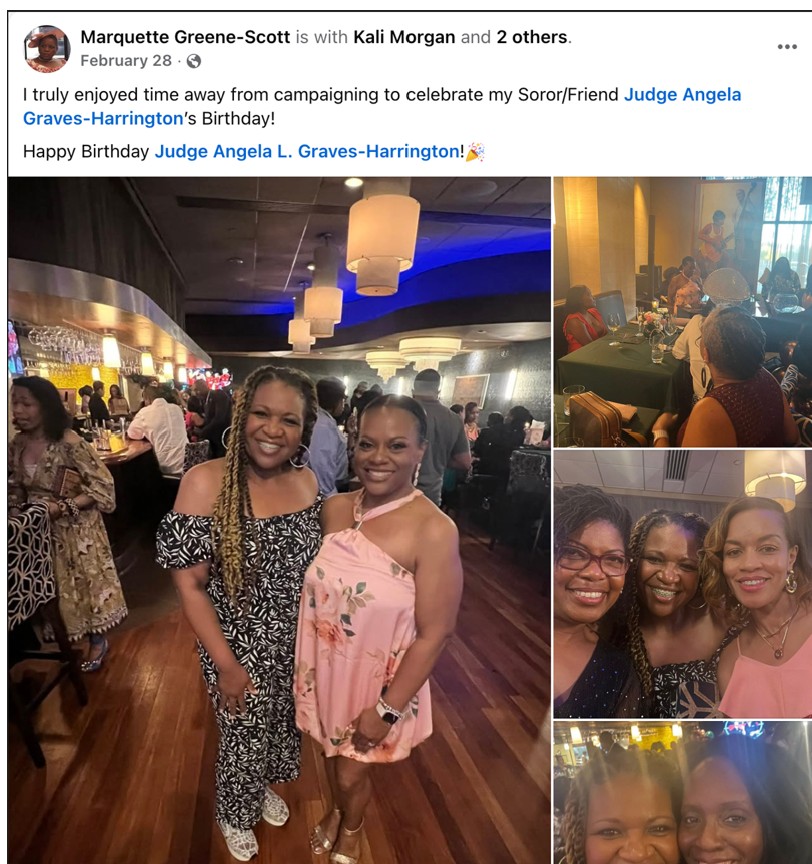
In 2026, the judge may have missed work, but she continued to post on social media, have fun in public, and speak at public events.
The Chronicle article said:
Graves-Harrington maintained public-facing commitments during her absences. She joined fellow jurists for a Black history month event at the 14th Court of Appeals on Feb. 11. She was later listed as a virtual speaker for two Houston Bar Association legal education events with other family law jurists on March 4 and April 1. She also sat at a sponsored table at the Houston Lawyers Association gala on May 2, where she presented a judicial award to a misdemeanor judge.
The Houston Chronicle story ran on June 14. Judge Graves-Harrington spoke at a seminar in Galveston on June 26 at in person in the middle of the day. She says she returned to work full-time on June 24.
Other Judges Have Had Enough
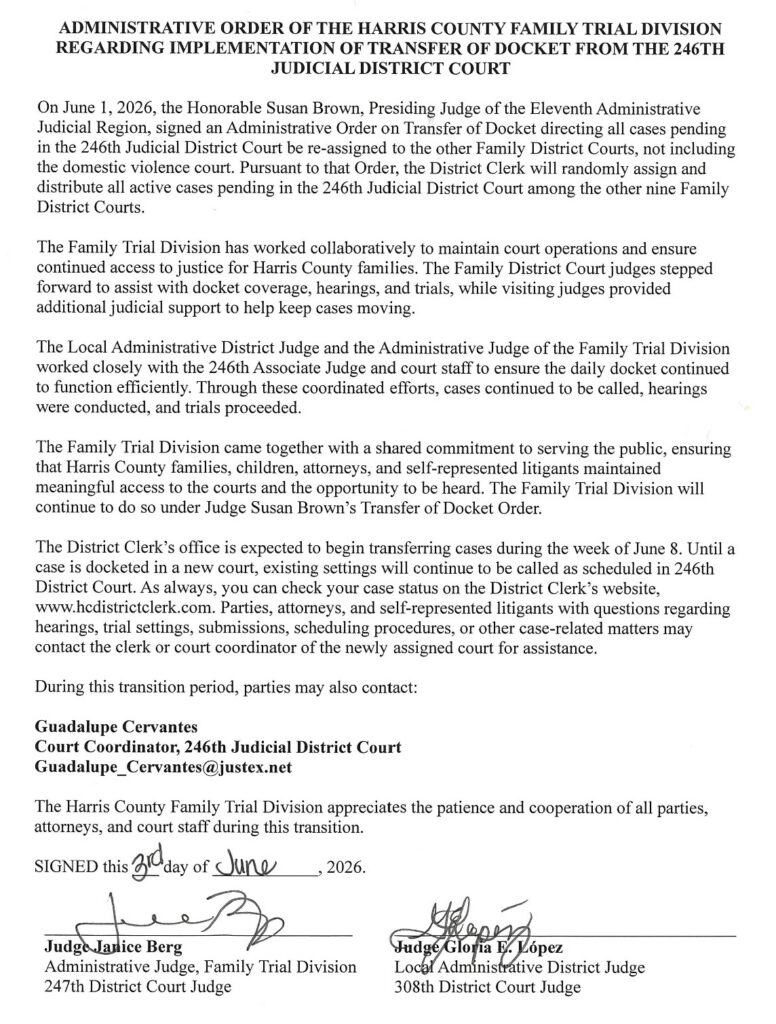
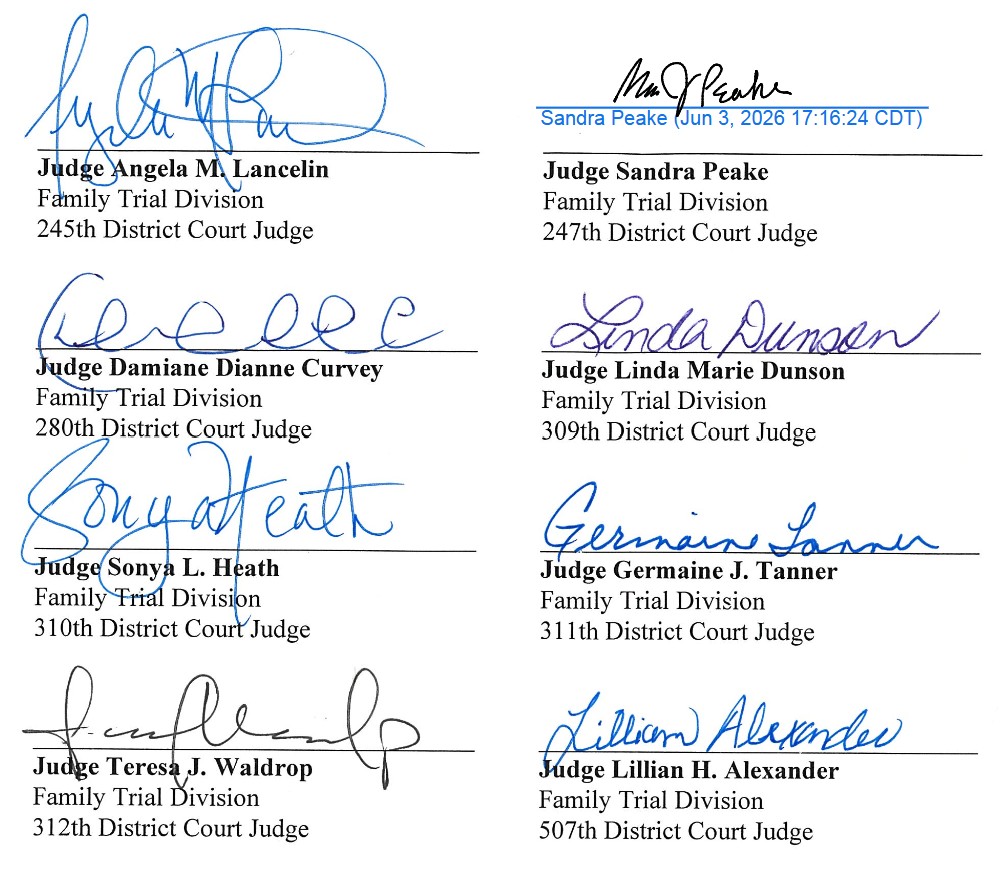
On June 1, 2026, the regional administrative judge, Susan Brown, signed an order reassigning all of the cases in Gaves-Harrington’s court to the other family courts and ordered that new cases would not go to the 246th District Court. Graves-Harrington’s fellow family court judges were all on the same page and the following order was issued:
On June 30, 2026, presumably because Graves-Harrington was back at work, Judge Brown signed an amended order which seems to give a few cases back to the 246th.
New divorce cases are not going to the 246th and pending divorce and post-judgment cases, such as enforcement and modification cases, taken from the 246th are largely not being transferred back.
Judge Graves-Harrington’s side of the story
The judge told me that her grief led her into a very dark place and she realized she was not in a position to be making decisions about other people’s lives. She maintains strongly that she deserves privacy even if she is a judge. Judge Harrington-Graves says she communicated with her fellow judges and cases were still being heard and moved during her absence. She points to statistics that show her court was closing more cases than several other family courts during her absence.
Judge Harrington-Graves told me that she always worked long hours every day as a judge before her husband’s death and she plans to return to that. The judge states that she is back full time. She told me about Judge Brown’s June 30 amended order and she sent me a copy. But, she seemed to think that all of her cases had been moved back. That clearly is not the case.
The judge I talked to was the poised, intelligent, well-spoken Graves-Harrington I met in 2017. She seemed genuine, determined, and somewhat vulnerable. She was a real person who happened to be a judge, who was still recovering from her world being turned upside down. She would not tell me all the details, but she honestly let me know how low she had sunk and how bad off she was for a while. The judge assured me she is much better and she now feels she is up to the challenge of being a judge again.
I have encouraged the judge to share some details of her story with the public so that we can all assess and understand her situation. Judge Harrington-Graves kindly sent me two emails that set forth her position, without providing an apology or any details of her mental health diagnosis or treatment.
Click here to read the judge’s side of the story in her own words, unedited by me. Judge her words for yourself.
If one of my employees missed eight months of work while I paid her full salary, I know I would be sympathetic, but I would expect more of an explanation that the judge is giving us now.
When this happens to other public officials
Harris County Judge Lina Hildago was off work for two months while she received in-patient treatment for clinical depression. Hildalgo was pretty open about her struggles with depression. Upon her return to work, Hildalgo issued a statement that said in part:
“Nobody would think twice about taking time off work to recover from a heart attack or another physical ailment, and it should be the same way for a mental illness. With the treatment I’ve received, it no longer feels like I’m in a constant fight against depression. I hope that others who are struggling will look to my experience and feel empowered to get the help they need instead of suffering in silence. ”
This situation seems similar to the absence of New Jersey Congressman Tom Kean for 117 days. Kean returned and gave a floor speech explaining that he was hospitalized for depression but he refused to answer questions. He did at least admit to a diagnosis of depression and he gave some details about his treatment. A June 30, 2026 article in the New York Times said this:
Speaker Mike Johnson indicated that he had urged Mr. Kean to share more about his condition earlier, to avoid rampant speculation that grew into a national fascination with the mystery of the congressman who had vanished. He told reporters that he had “encouraged him many times over the last few months” to be more transparent about his health. “If it were me, I would have been more specific about that,” he said, noting that Mr. Kean’s condition was very common.
. . . .
But some Democrats, including his challenger Rebecca Bennett, criticized Mr. Kean for his handling of the situation. “We give up our right to privacy when we run for office,” said Representative Maxine E. Dexter, Democrat of Oregon, who added that Mr. Kean had a duty to be more transparent.
. . . .
Experts said voters tend to be forgiving of politicians with medical problems, but less so when it comes to mental health. “Voters punish politicians who have mental illness more than they punish politicians who have an illness like cancer, for example,” said Peter Loewen, a professor of government at Cornell University and the Harold Tanner dean of the College of Arts and Sciences. Mr. Loewen, who published a paper in 2018 on depression among elected officials, said that “mental illness is still stigmatized for politicians in a way that physical illness is not.” “I can’t imagine it will help him,” he said of Mr. Kean’s speech.
. . . .
After Senator John Fetterman, Democrat of Pennsylvania, was hospitalized for six weeks in 2023 for treatment for clinical depression, he for a time tried to highlight the issue of mental health and encourage people to seek help if they were struggling. But last year, after scrutiny of his frequent absences from Capitol Hill, Mr. Fetterman told The New York Times in an interview that he regretted having been so open about his travails. “My doctor warned years ago: After it’s public that you are getting help for depression, people will weaponize that,” he said. “Simple things are turned. That’s exactly what happened.”
Maybe Judge Harrington-Graves has good reasons to be reluctant to disclose too much about her mental health struggles. I still think she should at least give us a few details of her diagnosis, treatment, and release to work.
Obviously, an elected judge, who is paid $218,000 a year, is treated differently than the other county employees who keep the courthouse functioning. Regular county employees would not be able to take eight months off work and still be paid. Harris County allows up to 12 weeks of unpaid FMLA leave for certain qualifying events in any 12 month period. A court clerk or bailiff who used up their paid leave and then missed over 12 weeks of work after the loss of a spouse would probably lose their job.
Insights on depression
The judge has not confirmed she was diagnosed with depression or treated for depression.
If she did have severe depression, it is possible for her to be unable to work but able to go fun events like the rodeo. The Cleveland Clinic website says this:
Atypical Depression, or what is commonly called high-functioning depression, involves mood reactivity—meaning your mood can temporarily improve or you can find enjoyment when positive, engaging things happen, but the underlying exhaustion and inability to sustain daily tasks like work persist.
One symptom specific to atypical depression is a temporary mood improvement in response to actual or potential positive events. This is known as mood reactivity.
Typical and atypical depression are both mental health conditions that involve prolonged feelings of sadness and hopelessness. The main difference is that in atypical depression, your mood can temporarily brighten as a result of positive events (such as a fun birthday party). In typical major depression, your depressed mood is usually constant.
Conclusion
I have always liked Judge Harrington-Graves and we all should want to see her healthy and successfully working full-time again. I hope that she and her associate judge show attorneys and parties the same empathy and understanding she wants us to now show her.
But, we deserve more information. If the judge was treated for depression, surely she should tell us that to explain her absence. If she received no treatment, should we really believe her story of being unable to work for so long? Is it not fair to expect the judge to show us something from her doctor, even a one sentence letter, stating that she is fully able to function as a judge? Would not every other worker in America be expected to do that?
In my next issue, I will share new developments, discuss case clearance statistics, and review the odds that the Republican legislature might impeach and remove the judge next Spring. I will also share reactions of attorneys praising and defending the judge. I am sure even more information will be revealed to me that I will pass on to my readers. There will be more to this story.
Again, please share photographs or social media posts, verifiable horror stories, and information about this situation or any other example of judicial abuse of power with me at greg@enoslaw.com.
This attempt at journalism reminds me why I retired The Mongoose in 2021. This takes a lot of time and I worry so much about getting my facts right and being fair. A real journalist would not want to hug the judge and tell her it will be all okay, despite what some a-holes may write. I hope Judge Graves-Harrington, her fellow judges, and my fellow attorneys read this story and decide I have tried my best to be accurate and even-handed, while still asking the tough questions that deserve answers.
I conclude with a few worthwhile quotes about grief:
“Grief is like the ocean; It comes in waves; ebbing and flowing. Sometimes the water is calm, and sometimes it is overwhelming. All we can do is learn to swim. “ — Vicki Harrison
“Grief is not a disorder, a disease, or a sign of weakness. It is an emotional, spiritual and physical necessity, the price you pay for love. The only cure for grief is to grieve.” — Earl Grollman
“Grief turns out to be a place none of us know until we reach it.” — Joan Didion
“Grief, I’ve learned, is really just love. It’s all the love you want to give, but cannot. All that unspent love gathers up in the corners of your eyes, the lump in your throat, and in that hollow part of your chest. Grief is just love with no place to go.”— Jamie Anderson
The recipe for winning a child custody case is to be a good parent, not do stupid things that will hurt your case, highlight problems with the other parent, and hire an experienced attorney who is good in the courtroom.
The legal standard that courts use for deciding a child custody case is “the child’s best interests.” It is not which parent is the biggest piece of crap. A winning child custody case emphasizes what is good about a parent and why he or she can provide the best home for a child. So, it seems obvious that you can win your custody case by being the best possible parent you can be.
Be the Parent the Judge Wants to See
Make it clear that you want your children to have a good relationship with the other parent. At soccer games, make sure the kids are comfortable going to talk to or sit with the other parent or his or her family.
You can really help to win your child custody case by avoiding doing stupid or mean things that make you look bad.
Tell the complete truth to your attorney and do not hide damaging information.
Tell the truth in court. Do not exaggerate.
Be willing to say good things about the other parent and give him or credit for having some good qualities.
Do not record your children. You can record the other parent if you are part of the conversation and you can do so secretly if needed.
Do not talk badly about the other parent.
Do not send mean, profane, condescending, or controlling messages to the other parent, and do not go overboard with long, repetitive communications. Watch what you say.
If ever there was a time to follow the “Golden Rule” and treat the other parent the way you want to be treated, it is during child custody litigation. Of course, that is how a good parent should behave all of the time. Do the right thing even if the other parent will not. Be nice even when the other parent is not.
Be involved with your children and know the names of their teachers, doctors, and dentists.
Attend the kids’ activities and know their friends and the parents of their friends.
Have fun with your children and really get to know them.
Document your parenting: keep a calendar, take photos, save school communications and appointment records.
Problems with drugs, alcohol, mental illness, or concerning sexual behavior need to be addressed. If the other parent has those problems, evidence of those issues needs to be gathered and presented. If you have had any major problems of that kind, your problems need to be admitted and openly discussed so that they can be addressed.
If you have made mistakes, admit them and show the judge you have learned from your errors.
Be careful about introducing new love interests to your child and ensure that step-parents stay within their roles and do not act like they are trying to replace the other parent.
Cooperate with your lawyer and paralegals. Respond to messages and promptly help with answering discovery requests.
Consider seeing a counselor to help you deal with the stress and emotions of a custody case. A counselor can help you to be a better parent if you are open to suggestions.
Stop using illegal drugs. Be moderate in your alcohol use.
Lastly, take care of yourself. Exercise, eat healthy, and find appropriate ways to deal with stress. You will be a better parent and a better client and witness in court if you are healthy and your head is screwed on right.
Courts want to know that a child placed primarily with you will be safe, supported, and well cared for. Witnesses who know you personally and have observed you parenting — neighbors, coaches, teachers, family members — can reinforce your credibility. The child’s therapist is often the most powerful neutral voice in a custody case.
529 plan accounts are assets to be divided in a divorce, although the divorce decree can make sure the funds are used for the child’s education. Otherwise, the spouse in control of the 529 account can use it for anything he or she chooses (with possible tax consequences).
Click here to read an article about 529 plan rules and tax advantages as of 2026.
529 plans are federally recognized savings accounts for children’s education, but they are held in one adult’s name and they are financial accounts to be divided in a divorce. 529 accounts are not trusts. Federal tax law provides that the earnings on 529 plans are not taxable income. If a parent uses 529 plan funds for a purpose other than the child’s education, the plan’s earnings are subject to being taxed as income and also incurring a 10% penalty, just like a withdrawal from a retirement plan before age 59½. 529 plan funds can be used for:
Tuition and fees
Books
Required school supplies
Room and board — the beneficiary must be at least a half-time student; includes off-campus housing up to the cost of on-campus room and board
Computers and related accessories, such as printers, internet access and educational software primarily used by the beneficiary
Up to $10,000 a year per beneficiary for elementary and secondary school (public, private and religious) tuition expenses.
Qualified costs associated with apprenticeship programs. Eligible programs can be offered through trade schools and community colleges and must be registered with the U.S. Department of Labor.
Student loans, up to a lifetime limit of $10,000 per student.
A rollover to a Roth IRA for the 529 beneficiary, subject to certain criteria and limitations.
Most 529 plans do not permit joint account ownership. Generally, a 529 account can only list one account owner (who controls the funds) and one beneficiary.
In re B.S., __ S.W.3d ___,No. 13-25-00130-CV (Tex. App. – Corpus Christi Edinburg 3/5/2026, no pet.) involved a divorce where the children’s 529 plans were placed under the sole and exclusive control of Wife by the agreed divorce decree. The wife was also awarded all brokerage accounts, stocks, bonds, mutual funds and securities registered in the wife’s name. In a later modification case, child custody was switched and the father convinced the trial court to change control of the 529 accounts to him. This order on the 529 accounts was reversed. The Court of Appeals explained:
It is undisputed that, at the time of the decree, the 529 accounts were composed entirely of funds earned by the parties during the marriage. Therefore, the accounts consisted of community property subject to a just-and-right division.
If the provision in the “Conservatorship” section of the decree did not award “ownership” of the accounts to Crystal, as Dusty claims, then there was nothing in it which would conflict with Paragraph P-10, which explicitly and unambiguously “awarded”to Crystal “[a]ll brokerage accounts, stocks, bonds, mutual funds, and securities registered in [her] name” as her “sole and separate property” and divested Dusty “of all right, title, interest, and claim in and to that property.” Dusty does not dispute that, though the accounts were intended to be used for the children’s education, they were assets of the type describedin Paragraph P-10, they were opened by Crystal, and they were registered in Crystal’s name. We conclude that the divorce decree awarded the 529 accounts to Crystal as part of the just-and-right division of the marital estate. The trial court’s finding to the contrary was error.
It is important to note that, although both parties agreed that the 529 accounts were intended to pay for the children’s education expenses, there was never any legal impediment restricting them from using the funds in those accounts to pay non-education expenses. A 529 account is not an irrevocable trust, the corpus of which may be considered property of the beneficiary, and the income of which may be excluded from community property under certain circumstances. Further, a 529 account is not considered an irrevocable gift or transfer to the beneficiary, as would be the case for an account established under the Uniform Gifts to Minors Act (UGMA). Instead, as Crystal indicated in her testimony, a 529 account is merely a savings account which remains owned by the person opening the account but is given favorable tax treatment under the Internal Revenue Code so long as withdrawn funds are used for certain “qualified higher education expenses.”
A divorce decree (and a mediated settlement agreement) should specifically award 529 plans to one spouse or the other. Here is an example:
Property to Respondent
IT IS ORDERED AND DECREED that Respondent, James Gary Jackson, is awarded the following as his sole and separate property, and Petitioner, Andrea Leigh Jackson, is divested of all right, title, interest, and claim in and to that property: ….
R-5. Charles Schwab New York 529 College Savings Program account number x89-01, for the benefit of Jack Lee Jackson.
The divorce decree could also provide:
It is agreed and therefore ORDERED that the Charles Schwab New York 529 College Savings Program account number x89-01, for the benefit of Jack Lee Jackson, shall be used exclusively for the higher education of Jack Lee Jackson and only for expenditures provided special tax treatment under 26 U.S. Code § 529, unless Andrea Leigh Jackson and James Gary Jackson agree in writing otherwise. IT IS FURTHER ORDERED that James Gary Jackson shall provide Andrea Leigh Jackson online access to Charles Schwab New York 529 College Savings Program account number x89-01to see transactions and statements.
Another option:
IT IS FURTHER ORDERED that James Gary Jackson shall before December 31, 2038 transfer any funds remaining in the Charles Schwab New York 529 College Savings Program account number x89-01 on December 19, 2038 (the 26th birthday of Jack Lee Jackson) as follows: The remaining funds, if any, shall be:
[choose one option]
___ Rolled over into a Roth IRA in the name of Jack Lee Jackson
___ Paid 100% to Jack Lee Jackson.
___ Paid 50% to James Gary Jackson and 50% to Andrea Leigh Jackson
A modification can only be granted if the change of circumstances proven relates directly to the modification requested.In re A.T.E., No. 01-19-00481-CV (Tex. App. – Houston [1st Dist.] 9/29/2020, no pet.)(mem. op.) involved a father who sought to modify a 2012 order that gave him supervised visitation because of his drinking. At the modification trial, the father showed that the child was older, both parents had remarried, he lived with a friend and he worked half the time in Saudi Arabia where alcohol was not allowed. The court of appeals held that the father had not met his burden to show that the modifications in visitation he wanted were related to the changes of circumstances since 2012.
These quotes from this case explain the holding and remind us which changes in circumstances are not enough to justify modification:
To prove that a material and substantial change in circumstances has occurred, “the evidence must show the conditions that existed at the time of the prior order as compared to the conditions that existed at the time of the hearing on the motion to modify.”
This Court has held that the substantial and material change that is relied on as the basis for modification must be material to the modification sought.
Identifying a change in one circumstance to seek a modification of another aspect of the custody arrangement improperly avoids the Legislature’s requirement that a substantial and material change be established to open the custody terms to modification. The requested modification must be “somehow connected to the changed circumstances” to permit reexamination of the custody terms. (stating, by example, that “a remarriage may require some changes but does not mean that the trial court may now modify other provisions in the original divorce decree unrelated to the remarriage”). Generally, a child’s aging is a contemplated event that will not constitute a substantial and material change. New marriages may qualify if they are shown to affect the parent-child relationship, but the mere fact of remarriage is not sufficient. Lee did not demonstrate how his or Samantha’s new marriages, even coupled with Anna’s older age, supported allowing Lee unsupervised, overnight visits, including international travel. Lee testified that he wanted a fuller relationship with Anna, with lengthier visits and opportunities to travel together. But a parent’s desire for a fuller relationship with a child is not a substantial and material change to warrant modification to remove a requirement that visits be supervised.