
Settlement & Mediation
Settlement of a case takes effort and experienced family law attorneys help their clients resolve their cases.
Mediation Flow
A simplified visual of how mediation usually moves a case toward settlement.
Review goals, documents, facts, and realistic court outcomes.
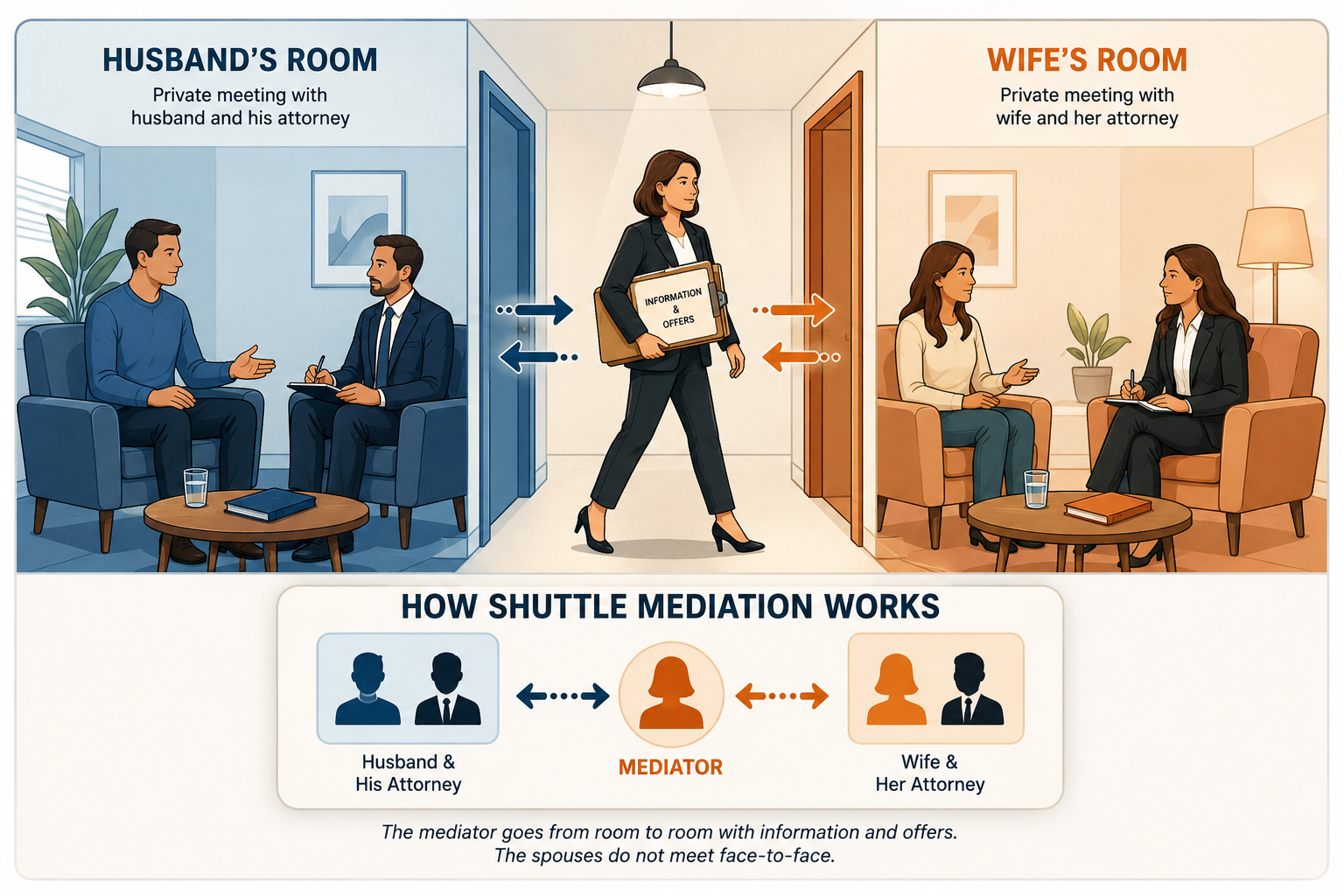
The mediator moves between rooms with offers and information.
If settled, the mediator drafts a Mediated Settlement Agreement.
The final order is prepared to match the settlement agreement.
01 The Goal of Settlement +
The goal of every divorce and child custody case should be to reach a fair, reasonable agreement and to avoid forcing a judge to decide the case. Settlement saves money that would otherwise be spent on attorneys and experts and reduces the emotional toll that family law cases extract from participants.
02 How Experienced Family Law Attorneys Help +
Settlement of a case takes effort and experienced family law attorneys help their clients resolve their cases by:
- Educating the client about the law and procedures applicable to the case, ensuring the client understands what is achievable and what is not feasible in court.
- In child custody cases determining the facts about the children’s needs and activities such as the parents’ roles prior to the separation, their work schedules, any bad behaviors in the past, and challenges such as addiction or mental health problems.
- In divorce cases ensuring that both the lawyer and client have a complete understanding of what community property is subject to division, the value of all assets and liabilities, the proof of separate property, and whether any claims such as fraud or waste or reimbursement can be made. Both sides need to realize that community property is not always split 50-50 but it is very rare for a spouse to be awarded more than 60% of community property.
03 What Settlement Is Based On +
Settlement is not based solely upon what a client wants; but on what is possible under the law and, most importantly, what the attorney thinks is likely to happen in court. For example, a client may want $3,000 a month in child support but a lawyer will explain that the maximum monthly support for one child is $1,840, and there is no reason to fight for more. Additionally, a lawyer’s experience with a particular judge may also influence settlement. For example, the attorney may know that a specific judge seldom grants overnight visitation for babies under the age of one and therefore will press the client not to fight for visitation he is very unlikely to win.
04 Client Discussions and Settlement Decisions +
Most attorneys appreciate it when their clients engage in discussions and reach a settlement on their own – as long as it is fair and not the result of bullying or fear, or made “just to get it all over with.” A bad settlement agreement can haunt a person for years and sometimes the lawyer earns his money by “saving the client from themself.” Talking a client out of a very bad settlement decision is very different than a lawyer intentionally prolonging a case just to earn additional fees. A lot boils down to the client’s trust in his or her attorney and assessing how much the attorney truly cares about what is best for the client.
Settlement can occur at any stage of a divorce and often involves the lawyers talking on the phone, sending emails and letters, and exchanging drafts of formal settlement agreements.
In Texas, a settlement agreement is not binding unless it is signed by the spouses or parents and their lawyers. Settlements in family court need a judge’s approval, except for mediated settlement agreements.
05 Mediation +
Mediation is one way to settle a case, but it is not the only way. Many cases are settled before or after mediation, and sometimes even on the day of court. Mediation is a formal (and slightly expensive) way to get the people involved in a case to focus on settlement. Mediation is required by most courts before final trial and is often required before hearings on temporary orders. Mediation involves a meeting (in person or electronically by Zoom) between you and your attorney, the other party and their lawyer, and a trained, impartial third-party settlement specialist called a mediator. In most instances, the mediator is also a lawyer. Mediations usually occur at the mediator’s office but may be held elsewhere or conducted via Zoom.
Mediation is a confidential settlement process, meaning that nothing said at mediation – including any offers back and forth – can be used in court. However, if either side learns something in mediation that they can obtain from another source after mediation, then that information can be used.
06 How Mediation Works +
Mediation begins with you and your attorney in one room, and the opposing party and their attorney in another room. Almost always, the parties will remain in separate rooms during the mediation, while the mediator goes back and forth between rooms transmitting information and offers.
The mediator’s job is to help the parties communicate, provide needed information, brainstorm for creative solutions, and play “devil’s advocate” by questioning each side’s position. Spouses and parents should not assume that the mediator is against you when this happens – they are not; it is merely part of their job.
07 Mediated Settlement Agreement +
If an agreement is reached, the mediator will draft a Mediated Settlement Agreement containing all of the terms of the settlement. That agreement is signed by both parties and their lawyers, and also by the mediator. That mediated settlement agreement is filed with the Court and is irrevocable. Once that document is signed, neither party can back out of it. The case is over, other than the preparation and entry of the final order (which must match the content of the agreement).
If the parties are not able to reach an agreement at mediation, then the judge is informed only that the parties did not settle. Due to the confidentiality rules of mediation, the judge cannot be told what each side said or offered during the mediation session.
08 Preparing for Mediation +
Most cases settle at mediation. You need to seriously think about what you want, what is fair, what is best for your child/children, and what realistically is possible to achieve in court when preparing for mediation. You should also consider the cost of not settling, which includes paying for our firm to prepare for and attend trial.
Mediations are scheduled for either a full day (8+ hours) or a half day (4.5 hours usually). Mediation can run long if the parties are close to an agreement at the end of the scheduled time. The cost of mediation includes the mediator’s fee ($450 – $600 for a half day from each side and $800 to $1,500 per side for a full day) and the cost of paying your lawyer to attend ($1,600 to over $4,000 for an extra-long mediation). The cost of mediation is worth it if your case is settled.
It is important to remember that mediation is required in most cases, and in most cases, mediation settles the lawsuit. Your attorney and staff will meet with you to prepare for mediation and may ask you to provide updated financial documents such as current paystubs, W’2 and 1099’s, current account statements, and property spreadsheets.